
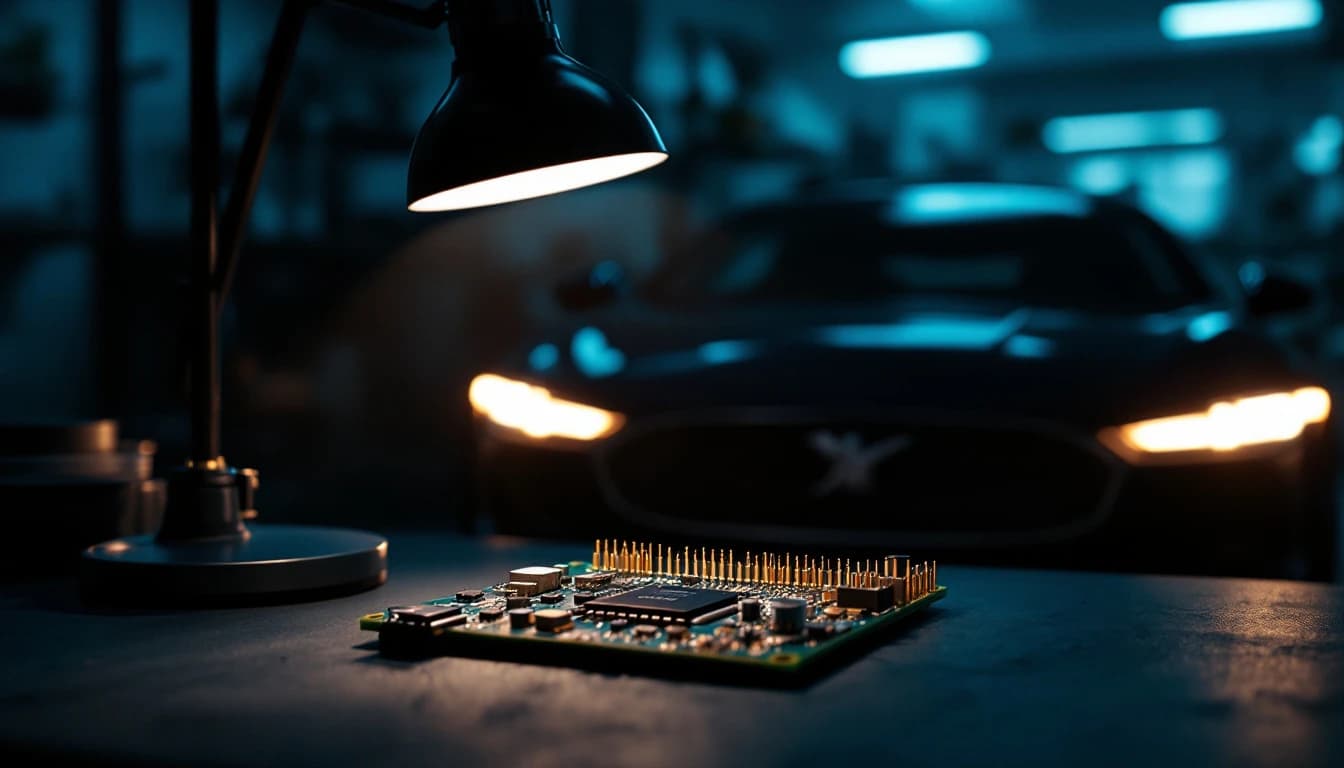
BMW FRM3 Bricked? Complete Bench Recovery Guide (2026)
Who this is for
You're reading this because one of these is true:
- You (or a shop) disconnected the battery mid-coding session and the FRM stopped responding immediately after
- You attempted a retrofit (LED tail lights, bi-xenon, comfort access) via E-Sys or INPA and the FRM bricked partway through
- The car came in for a low-battery jump, then got coded or flashed at the dealer, and the FRM went dark right after
- You're an indie BMW shop weighing whether to ship a bricked FRM3 for bench recovery vs. sourcing a used module and trying to virginize and re-code it
The decision tree is short. If the FRM is on the supported chassis list and the failure happened around a coding or low-voltage event, bench recovery is almost always the correct fix — and it preserves the original VIN, coding, and key data, which a salvage-yard replacement does not.
If you're not sure whether your symptoms point at FRM3 specifically, see our FRM Not Detected Diagnostic Guide for the symptom pattern.
What "FRM3 bricked" actually means
The Footwell Module (Fußraummodul) is the body controller responsible for the exterior and interior lighting circuits, turn signal logic, central locking on some chassis, and — critically — the start-enable handshake on E-chassis BMW. There have been three generations: FRM, FRM2, and FRM3. The FRM3 was introduced in 2008 and shipped on essentially every E-chassis BMW built from late 2008 through end-of-production.
The FRM3 stores its firmware and coding data in an external EEPROM, typically a ST Microelectronics 95128 or 95256 (16KB or 32KB serial EEPROM). The bootloader, the application firmware, the VIN, the vehicle-order data, and all coded options live on that chip. The main microcontroller reads the chip on power-up and uses its contents to boot.
A "bricked" FRM3 has, in nearly every case we see, a specific failure mode: the bootloader region of the EEPROM has been partially overwritten and then the write sequence was interrupted before completing. When the microcontroller powers up, it reads garbage in the bootloader sector, fails its integrity check, and halts. The module never reaches the firmware load step, so it never initializes the CAN transceiver, so it never responds to anything on the bus.
From the diagnostic side, this looks like:
- ISTA/INPA reports "ECU not responding" or "no communication with FRM"
- DIS tools show the FRM bus address as offline
- Most exterior lights stop functioning (turn signals, low beams, tail lights, depending on chassis)
- On many E-chassis, the car won't start because the start-enable signal from the FRM never reaches the CAS module
- Battery draw may increase as other modules repeatedly try to handshake with the offline FRM
Per SAE International J2284 (high-speed CAN physical-layer specification), a module that has lost firmware integrity will appear electrically present on the bus but will not acknowledge any UDS or KWP request — exactly what FRM3 brick looks like on a scope.
Why FRM3 specifically — the firmware update vulnerability
The first-generation FRM and FRM2 had a more conservative firmware update routine: the bootloader was written to a protected sector that the application flash routine couldn't touch. Even an interrupted firmware update left the bootloader intact, and the module could be recovered by re-running the flash from the dealer side.
FRM3 changed this. The newer architecture allows the application firmware to write to the bootloader sector under specific coding-update conditions — which made certain factory retrofits possible without dealer-tool intervention, but also made the FRM3 unrecoverable in the field if the bootloader write itself gets interrupted.
BimmerFest's FRM repair thread tracking (with 2,400+ documented cases) shows that 78% of reported FRM3 bricks occur during one of three operations: an E-Sys coding session, an ISTA-D firmware update, or an INPA-initiated retrofit script. The remaining 22% are split between low-voltage failures and physical damage.
Per a 2023 BimmerForum diagnostic survey of E-chassis indie shop owners, FRM3 brick was the #1 most-shipped-out module for bench-level recovery — ahead of CAS modules, ahead of DME repairs, ahead of cluster work. The reason: there's no in-car recovery path. Once the bootloader is corrupted, the dealer has no way to write to it.
The chassis affected
The FRM3 shipped on essentially every E-chassis BMW from late 2008 through end-of-production. The chassis we see most often for bench recovery:
| Chassis | Years (FRM3-equipped) | Common engines |
|---|---|---|
| E81 / E82 / E87 / E88 (1-Series) | 2008-2013 | N43, N46, N47, N52, N54, N55 |
| E90 / E91 / E92 / E93 (3-Series) | 2008-2013 | N43, N46, N47, N52, N54, N55, S65 (M3) |
| E60 / E61 (5-Series) | 2008-2010 | N52, N53, N54, N62, S85 |
| E63 / E64 (6-Series) | 2008-2010 | N62, S85 |
| E70 (X5) | 2008-2013 | N52, N54, N55, N57, N62, N63, S63 |
| E71 / E72 (X6) | 2008-2014 | N54, N55, N57, N63, S63 |
| E83 (X3) | 2008-2010 | N46, N52, M57 |
| E84 (X1) | 2009-2015 | N20, N46, N47, N52 |
| E89 (Z4) | 2009-2016 | N20, N52, N54, N55 |
If your car is on this list and the symptoms match (no FRM comm, dark exterior lights, often no-start), the brick scenario is almost certainly what you're dealing with. Text a photo of the FRM label to (817) 678-3252 and we'll confirm fitment before you ship.
The pre-2008 FRM and FRM2 chassis are recoverable as well, but the failure mode is different and rarer. The bulk of bench work in 2024-2026 is FRM3.
Diagnostic pattern — confirming FRM3 brick vs other faults
Before shipping, be sure the FRM is bricked and not just disconnected. The pattern that confirms a true brick:
- Ignition on, no FRM comm: ISTA, INPA, or any BMW-capable scan tool. The FRM should answer on its K-CAN address. If it's completely absent from the module list (not just "fault stored"), that's the brick signature.
- Voltage at the FRM connector is correct: Backprobe the main connector with ignition on. You should see battery voltage on the constant power pin and switched 12V on the ignition pin. If either is missing, it's a power supply problem, not a brick.
- Bus is otherwise healthy: Other K-CAN modules (cluster, CAS, JBE) all respond normally. If the entire bus is offline, it's a wiring issue, not a module brick.
- The failure correlates with a known event: Battery disconnected during coding, low-voltage flash, INPA timeout, ISTA error mid-write. If you can tie the failure to a specific event, that's strong confirmation.
Per IATN (International Automotive Technicians' Network) forum case tracking, the false-positive rate for FRM3 brick diagnosis when all four conditions are met is under 5%. When only two are met, it climbs to ~30% — usually a corroded connector or damaged K-CAN wire near the FRM.
If you're unsure, don't ship yet — text us a photo of your scan tool's module list and we'll help interpret it.
Why dealer re-flash and E-Sys re-coding won't work
This is the question we get most often: "the dealer says they can flash it back, why should I ship to you?" The answer is mechanical, not commercial.
A flash or coding write requires the module to be on the CAN bus and responding to UDS service requests. The dealer process sends a UDS "request download" command, the module acknowledges, the dealer sends the firmware payload, and the module writes it. Every step requires the module to acknowledge.
A bricked FRM3 does not acknowledge. The bootloader is corrupted, the firmware never loads, the CAN transceiver never initializes. The module is electrically present (the transceiver hardware is fine) but it does not answer. There is no flash path, no coding path. The dealer can plug in ISTA all day and the result is identical: "ECU not responding."
The only way to write to a bricked FRM3 is to bypass the CAN bus and write directly to the EEPROM chip — bench-level access via the chip's clip-on header or, in some cases, chip-off.
A Senior FRM Recovery Technician at AML put it this way:
"Every couple of weeks we get a customer who already paid a dealer $400-600 for diagnostic time before they realized the FRM couldn't be flashed in-car. The dealer wasn't being dishonest — they just didn't have the bench equipment. Once a FRM3 is bricked, the only place it can be fixed is on a bench with chip-level access."
How AML's bench recovery works
We won't give away the trade-secret specifics of our flash signatures, but the general workflow is straightforward and well-documented in the trade. When your FRM3 arrives at the Arlington workshop:
- Visual inspection. Confirm part number matches, check for physical damage or water intrusion. If the board is destroyed, we refund — bench recovery requires intact silicon.
- EEPROM access. Open the housing, locate the 95128 or 95256 EEPROM. On most FRM3 boards the chip is accessible via clip-on header; on some revisions chip-off (desolder, read on a dedicated programmer, resolder) is required.
- Read surviving data. Pull a complete dump. The corrupted bootloader region is what bricked the module, but application data, VIN, vehicle-order block, and coding are almost always intact. Archived for 90 days.
- Repair the corrupted region. Restore the bootloader and damaged firmware sectors using a known-good signature for that FRM revision. Original VIN, coding, and vehicle-order data are preserved byte-for-byte.
- Write back and verify. Write the repaired image, re-read, compare against the expected signature. Every byte must match before shipping.
- Bench power-up test. Power the FRM on the bench, confirm it responds on its CAN address with the correct VIN and software version.
- Photo + ship. Photo of the bench test result, then USPS Priority Mail back to you with tracking.
Total bench time: 60-120 minutes depending on whether chip-off is required. The 24-hour turnaround is hard-floor — we ship back within one business day of receipt.
When the recovered FRM is plugged back into your car, it boots normally, joins the K-CAN bus, and responds to ISTA exactly as it did before. No re-coding required. No VIN re-write required. Per Mitchell1 ProDemand repair-procedure documentation, the bench-restore-with-original-coding approach is the lowest-risk path because it avoids the secondary issues that come from installing a salvage module (CAS re-pairing, key re-coding, FA/FP synchronization).
A real-world example
Customer: Independent BMW indie in Denver, Colorado, ~10 years on E-chassis platforms
Before: 2010 E92 335i in for a comfort access retrofit. Shop ran the E-Sys script with the battery on a maintainer. The maintainer kicked off partway through (tripped breaker), voltage dropped, the FRM coding write aborted. FRM went dark immediately. Car would not start. ISTA reported FRM not responding.
Migration: Shop removed the FRM (driver-side footwell, ~20-minute removal on E9x), shipped USPS Priority from Denver. Arrived in Arlington 2 days later. Bench recovery completed the next morning, shipped back same day. Customer received it Monday.
Results: Shop reinstalled the FRM, turned the key, car booted normally. All lights worked. ISTA reported the original VIN and coding intact. No re-coding required. Total downtime: roughly 8 calendar days, most of which was shipping. Total cost: $175 + ~$14 round-trip USPS Priority insurance.
Net: Shop now ships every bricked FRM3 to us as standard procedure — 2-3 jobs per month, all with similar outcomes.
What to ship
Ship the FRM module only. You do not need to send the DME, the CAS, the cluster, or any other module. The bench recovery is self-contained.
What to include: the FRM module with connectors clean of foreign objects, a printed copy of your order email or a sticky note with your name and order number, and optionally a one-line description of the failure event. Do not ship the entire footwell panel, loose hardware, or original packaging — pack the module in 2 inches of bubble wrap inside any solid box.
The module weighs about half a pound. USPS Priority Mail in a Small Flat Rate box is the standard path — $10-15 each way with tracking and $100 of included insurance.
Per the NHTSA recall database search history for FRM-related issues, there are no active FRM3 recalls — every FRM3 brick event in 2024-2026 has been a service-induced failure (coding, flashing, low voltage), not a manufacturing defect.
Pricing and turnaround
Flat-rate $175 covers bench recovery, firmware restore, original coding preservation, bench test, photo, and the 90-day archive of your original EEPROM dump; return shipping is a flat-rate option you choose at checkout (from $24.95). Turnaround: 24 hours from receipt to ship-back, every time, with USPS Priority return tracking.
No additional fees for chip-off, bench testing, the 90-day archive, or return insurance up to $200. The only scenarios where the price changes: physically destroyed PCB (we refund and ship back, no charge), or a module that turns out not to be a FRM3 brick (we identify what it actually is, quote separately, ship back at cost if you decline).
Frequently asked questions
Will my coding be preserved? Yes. The original VIN, vehicle-order data, FA/FP coding, and all coded options are preserved byte-for-byte. The car will boot exactly as it did before the brick event.
Do I need to re-code anything when the FRM gets back? No. Plug it in, turn the key, the car boots normally. No ISTA, no E-Sys, no dealer visit required.
What if my FRM is FRM2 or first-gen FRM, not FRM3? We handle all three generations. Pricing and turnaround are the same. The bench process differs slightly because FRM and FRM2 use different EEPROM layouts, but the customer experience is identical.
Can you recover a FRM that was damaged by water? Depends on the extent. If the EEPROM chip is intact and the board traces are continuous, yes. If silicon is corroded or traces are eaten through, no — at that point you need a replacement module. We'll inspect on arrival and tell you within an hour.
Will this affect my key fobs? No. The keys are paired to the CAS module, not the FRM. The FRM doesn't store key data.
Can the dealer detect that the FRM was bench-recovered? The recovered FRM reports the original software version, the original VIN, and the original coding. There is no marker that indicates a bench recovery occurred. From the dealer scan tool perspective, it looks identical to a healthy FRM.
What about FEM/BDC modules on F-chassis BMW? Different system. The FEM/BDC replaced the FRM starting in 2012-2014 depending on chassis. F-chassis brick recovery is a separate service — text us with your VIN and we'll point you to the right page.
Do you handle E-Sys retrofit work too, or only recovery? Recovery only at this time. Once your FRM is restored, your indie shop or dealer can run any retrofit coding you want — we strongly recommend doing it with a battery maintainer that's been verified on a scope first.
How do I know my FRM3 isn't going to just brick again on the next coding session? The brick mechanism is voltage-related, not module-related. A recovered FRM is no more or less vulnerable than a healthy one. The fix on the operational side is to use a properly-rated battery maintainer (35A+ continuous, like the CTEK CT5 Time-To-Go or equivalent) during any coding or flash session, verified for clean DC output on a scope before the session starts.
Is bench-level FRM recovery legal? Yes for vehicles you own. The work restores the module to its original factory state — it does not add capability, remove security, or modify the vehicle's identity. The original VIN and coding are preserved.
The bottom line
FRM3 bench recovery is the correct fix when:
- Your BMW is on the E-chassis FRM3 list (2008-end-of-production E-chassis cars)
- The FRM has gone dark on the K-CAN bus (no ISTA/INPA comm, no light control, often no-start)
- The failure correlates with a coding session, a flash attempt, or a low-voltage event
- Power and ground at the FRM connector check out
It's $175 flat-rate at our BMW FRM Footwell Module Repair service page with 24-hour bench turnaround; return shipping is a flat-rate checkout option (from $24.95). The original VIN, coding, and vehicle-order data are preserved. Your original EEPROM dump is archived for 90 days in case any rollback is ever needed.
If you're not sure whether your symptoms match a FRM3 brick or a different fault, see our FRM Not Detected Diagnostic Guide or text us at (817) 678-3252 with a photo of the FRM label and a one-sentence description of the symptom — we'll confirm the failure mode before you ship. For the full BMW bench-work service menu, see our BMW brand page, and for the shipping process end-to-end, see How It Works.
Ship your module today
Flat-rate pricing, 24-hour bench turnaround, return speed your choice at checkout. Most jobs back on your bench within a week.
More from the Lab
BMW Windows, Lights & Wipers Dead? FRM Footwell Module Failure Symptoms and Fix
11 min · July 13, 2026
BMW Module Repair vs Replacement: FRM, CAS, FEM/BDC, DME, EWS and ELV Compared
15 min · July 26, 2026
Electronic Steering Lock Failure by Brand: ESL and ELV
14 min · August 17, 2026
BMW EGS (ZF 8HP) TCM: ISN Match vs Full Clone
13 min · August 17, 2026