
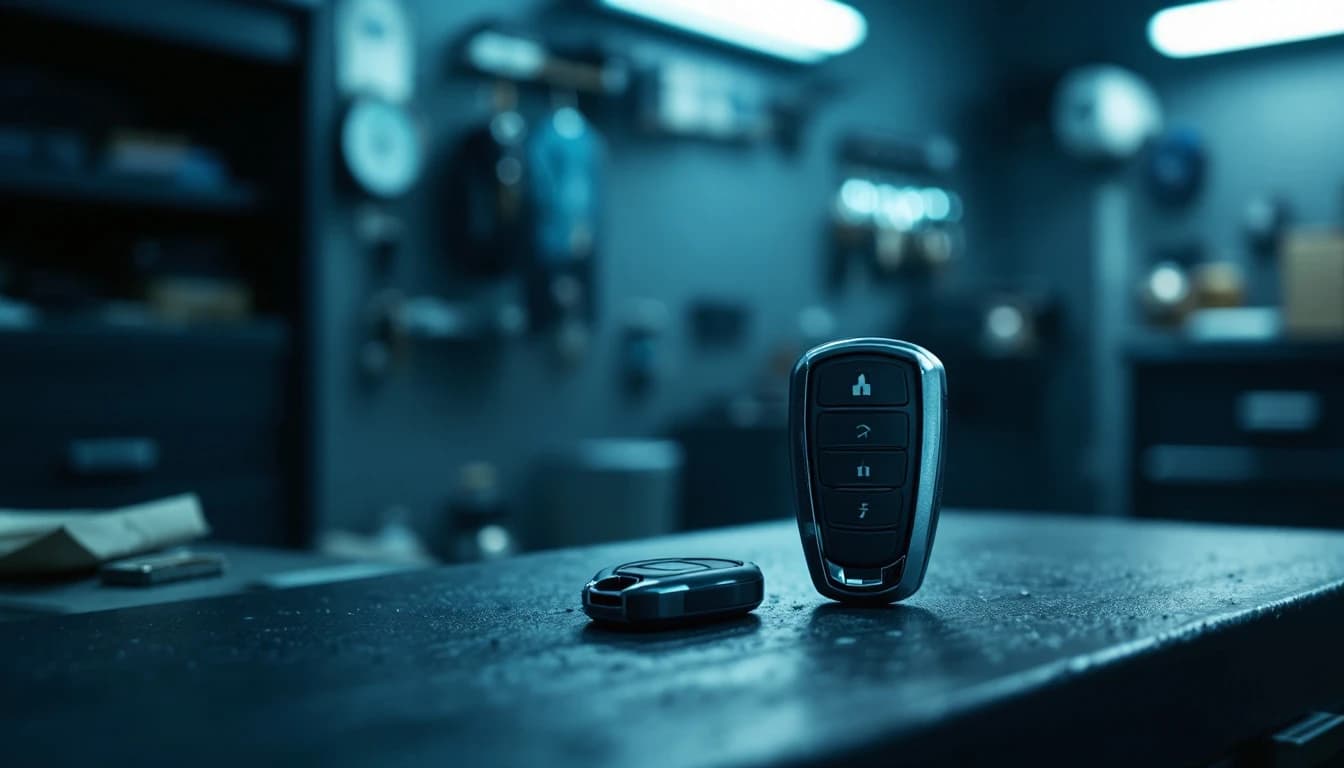
All Keys Lost? Why Mail-In Module Programming Is Often the Only Fix (Every Brand)
What "all keys lost" actually means
"All keys lost" — AKL for short — is exactly what it sounds like: there is no working key left for the vehicle. Not a spare in a drawer, not a valet key, nothing that will crank and start the engine. That single fact changes everything about how a new key gets made, because the normal way to add a key relies on already having one.
On almost every car built in the last twenty-five years, the key is only half the story. The other half is the immobilizer — an electronic anti-theft system that checks a coded credential in the key against a value stored inside a control module before it lets the engine run. When a locksmith "adds a key," what they're really doing is teaching that module to trust a new credential. If you hand them a working key, most systems let them do that quickly through the diagnostic port, because the existing key proves authorization.
Take away every working key and that shortcut disappears. Now the technician has to convince a security system to accept a brand-new, unknown key with nothing to authenticate against. On simple older cars that's a timed on-board procedure. On modern encrypted platforms it often means the immobilizer module itself has to be removed, opened, read on a bench, and sometimes rewritten before a virgin key will ever work. That is the heart of why mail-in module programming exists — and why, for some brands, it's the only realistic fix.
Before we go further, one rule that never bends: AKL and key work require proof of ownership. We ask every customer for a copy of the title or current registration plus a matching government photo ID before we accept an immobilizer or key job. That's not red tape — it's the line that separates legitimate locksmithing from helping someone steal a car, and every reputable shop draws it.
Why lost keys became an expensive problem
Modern immobilizers work. The insurance and crime data make that clear. The Insurance Institute for Highway Safety has credited electronic engine immobilizers with sharp long-run declines in theft rates for equipped vehicles, and the National Highway Traffic Safety Administration has likewise pointed to anti-theft immobilizer technology as a factor in reducing theft of equipped vehicles. The technology is now effectively universal on new cars sold in the United States. The same encryption that frustrates a thief also frustrates the owner who loses every key — the system is designed to be hard to talk to without authorization.
The scale of the underlying problem is large. The National Insurance Crime Bureau has reported that vehicle theft in the United States has topped roughly one million vehicles a year in recent reporting periods, and the FBI's Uniform Crime Reporting program tracks motor-vehicle theft as one of the highest-volume property crimes nationally, with property lost to it running into the billions of dollars annually. Every one of those events, and every simple lost-keys event, eventually needs a key made — and on newer cars, that increasingly means module-level work.
Cost data tells the same story. Consumer-vehicle references such as Kelley Blue Book and Carfax have both documented how a modern smart-key or proximity key, once you account for the blank, the cut, and the programming, routinely runs from the low hundreds of dollars into four figures on luxury European platforms — far above the few dollars a hardware-store copy used to cost. Enthusiast and ownership outlets such as Hagerty have run similar explainers on how proximity-key replacement costs have climbed as immobilizer electronics grew more complex. When the job crosses from "cut a blade" to "program encrypted electronics," the price reflects the equipment, the licensing, and the time involved.
"The moment a customer tells me every key is gone on a late-model BMW or a Range Rover, I already know we're probably pulling a module. People expect the driveway visit they got on their old Honda, and I have to reset that expectation — on these platforms the security lives in a chip that has to come out and go on the bench. It's not that anyone's being difficult; the car is built to say no." — Master automotive locksmith, 20+ years in European key and immobilizer work (anonymized)
The platforms that lock you out
Not every car needs a module pulled when keys are lost. Plenty of mainstream vehicles can still be done through the diagnostic port even in AKL. The trouble concentrates on encrypted European platforms where the security architecture was deliberately hardened. Here are the big ones we see.
BMW — CAS and FEM/BDC. For much of the 2000s and 2010s, BMW's immobilizer lived in the CAS (Car Access System) module; later cars moved it into the FEM/BDC (Front Electronic Module / Body Domain Controller). On many of these, all-keys-lost means the module comes out so the key data can be read and a virgin key written on the bench. Our BMW CAS key programming service handles the CAS-family side of that at a flat $150 for the bench work.
Mercedes-Benz — EIS/EZS. The EIS (Electronic Ignition Switch, also called EZS) is the brain of the Mercedes immobilizer. It's heavily encrypted, and AKL work typically requires reading the EIS on the bench, calculating or recovering the key data, and programming a new key to it. That's exactly what our Mercedes EIS key programming covers at a flat $150 for the module programming.
Range Rover and Jaguar Land Rover — KVM. Newer JLR vehicles centralize key and security functions in the KVM (Keyless Vehicle Module). When keys are lost, the KVM often has to be read and, in many cases, "virginized" — reset to a factory-clean security state — before new keys can be paired. Range Rover and Jaguar smart-key programming is one of the more involved and higher-value jobs in the shop, which is reflected in the pricing.
Volvo — CEM. Volvo's CEM (Central Electronic Module) holds immobilizer data on a wide range of models. All-keys-lost frequently means the CEM comes out to be read and, depending on the platform, cloned so a key can be generated.
Volkswagen / Audi. VW and Audi have used several immobilizer generations, and on the harder ones the immo data lives in components — clusters, comfort modules, or dedicated immo boxes — that must be read on the bench to recover the credential a new key needs.
The common thread is simple: the authorization these systems demand lives in silicon that, when there's no working key to lean on, has to be reached directly. A mobile visit that expects to plug into the OBD port and finish in twenty minutes runs into a wall.
Why a driveway visit often can't finish the job
There's nothing wrong with mobile locksmiths — for the right car, an on-site key is fast and convenient. The mismatch happens when the platform demands bench access and the mobile setup can't provide it. Three things typically get in the way.
First, module removal. Reading a CAS, EIS, KVM, or CEM usually means physically taking the module out of the car, opening it, and connecting to it directly — soldered points or a bench harness in the harder cases. That's controlled shop work, not a task for a car seat in a parking lot.
Second, read, clone, or virginize steps. Some jobs aren't just "add a key." The module has to be read out, its security state understood, and in cloning or virginizing cases rewritten — data operations where a single power hiccup can corrupt the module. A regulated bench supply and the right programmer matter here in a way a portable kit rarely matches.
Third, equipment and licensing. The tools that talk to encrypted European immobilizers are expensive, frequently licensed per platform, and updated constantly. A generalist mobile locksmith may simply not own the specific tool your VIN needs, whereas a bench specialist concentrates that investment on exactly this work.
That's the gap mail-in module programming fills. Instead of hoping a mobile tech happens to carry the exact platform tool, you send the specific module to a bench that specializes in it, get it programmed correctly, and reinstall it.
Tow to a dealer, or mail the module in?
When you're standing next to a car you can't start, you have three realistic paths. Here's how they compare on the dimensions that matter.
| Factor | Dealer (tow in) | Mobile locksmith on-site | Mail-in bench programming |
|---|---|---|---|
| Handles encrypted AKL (CAS/EIS/KVM/CEM) | Usually yes | Only if they own the exact platform tool | Yes — this is the specialty |
| You keep the whole car at the dealer | Yes (days) | No | No — you send only the module |
| Typical cost posture | Highest | Varies; can decline hard platforms | Flat bench price + your return shipping |
| Proof of ownership required | Yes | Yes | Yes — every time |
| What travels | The whole vehicle (tow) | The tech comes to you | One small module in a box |
| Best when | You want everything done in one place | Your car is on a supported, easier platform | The platform needs bench read/clone/virginize |
The decision usually comes down to one question: does your specific platform need the module on a bench? If it does, the dealer will tow the whole car in and charge accordingly, a mobile tech may not be able to finish it at all, and mailing in just the module is the leanest path — you ship a part, not a vehicle. If your car is on an easier platform that can be done through the port, a good mobile locksmith may be the quickest option and mail-in isn't necessary.
One practical note: on a true all-keys-lost, the car won't start until the newly programmed key is back in it. That means either the module makes a round trip while the vehicle sits, or the vehicle gets towed to wherever the work happens. Mail-in keeps the towing out of it — the car stays where it is and only the module travels. You can always start at our services hub to see whether your platform is one we handle on the bench.
The mail-in workflow, step by step
The whole point of bench service is that you ship a part instead of moving a car. Here's the sequence we run.
- Confirm ownership and fitment first. Text us your VIN, the year/make/model, and which module you believe is involved, along with a copy of the title or registration and a matching photo ID. Nothing is programmed until ownership is confirmed and we've verified the platform is one we service. This step is mandatory on every key and immobilizer order — no exceptions.
- Identify and remove the module. We confirm exactly which unit to send — CAS or FEM/BDC on a BMW, EIS on a Mercedes, KVM on a Range Rover or Jaguar, CEM on a Volvo, or the relevant immo component on a VW/Audi. You (or your shop) remove it and pack it carefully in an anti-static bag inside a padded box.
- Ship it to the lab. Send the module to PO Box 120241, Arlington TX 76012 if you ship USPS — or 1009 Oakwood Ln # 120241, Arlington TX 76012 if you ship UPS or FedEx (UPS and FedEx cannot deliver to a PO Box). You choose your inbound carrier; return shipping back to you is a flat rate you select at checkout, from $24.95, and is paid by you.
- Bench read and archive. On arrival we power the module on a regulated bench supply, read its current state, and archive the original data before making any change — so there's always a known-good baseline.
- Program, clone, or virginize as the platform requires. Depending on the module and the situation, that means writing a virgin key to it, cloning it to a replacement, or virginizing it to a factory-clean security state so new keys can be paired.
- Verify and return. We confirm the module communicates correctly on the bench, then ship it back with tracking via the return tier you chose. You reinstall it, pair your key if any final in-car step is needed, and the car starts.
Because the read-and-write steps happen on a clean, regulated supply rather than in a car with a marginal battery, the bench is also the safest place to do the riskier cloning and virginizing operations — a voltage sag mid-write is one of the classic ways a module gets bricked in the field.
What bench key programming does and does not do
Being precise about scope saves everyone grief.
What the bench service does: it reads your immobilizer module, recovers or calculates the key data where the platform allows, and programs a working key — or clones/virginizes the module so keys can be paired. It restores the ability to start the car with a properly authorized key.
What it does not do: it does not cut a mechanical blade for you unless that's arranged separately, it does not fix unrelated electrical faults in the module, and it never bypasses the ownership check. If the security architecture of a specific VIN genuinely cannot be serviced on the bench, we tell you before you ship anything rather than take an order we can't complete. And it is never a way around proving the car is yours — that requirement is fixed.
For deeper platform-specific detail, two companion guides are worth reading alongside this one: our walkthrough of what to do when a Range Rover loses all keys, and our explainer on what a VIN-locked module means and what to do about it, which matters because many replacement modules arrive locked to a different VIN and need bench work before they'll ever function.
The prices, by platform
Bench programming prices for the platforms covered here are flat and quoted up front, with return shipping paid by you from $24.95:
- BMW CAS key programming — $150. The CAS-family bench work to add a key or recover an all-keys-lost BMW on supported CAS platforms.
- Mercedes EIS key programming — $150. Reading the EIS/EZS and programming a new key on supported Mercedes platforms.
- Range Rover / Jaguar key programming — $550. The more involved smart-key programming JLR platforms require, reflecting the equipment and time these encrypted systems demand.
- Volvo CEM key programming / clone — $250. Reading and, where needed, cloning the CEM so a key can be generated.
- JLR KVM virginize — $300. Resetting a Keyless Vehicle Module to a factory-clean security state so new keys can be paired.
Mechanical key cutting, any parts, and your inbound and return shipping are separate from the bench programming fee. We confirm the exact service and price for your VIN before you ship, so there are no surprises.
Frequently asked questions
What does "all keys lost" mean, and why is it harder than making a spare? All keys lost means no working key exists for the car, so a technician has nothing to authenticate a new key against. Making a spare is easy because the existing key proves authorization; AKL forces the immobilizer to accept an unknown key cold, which on encrypted platforms means reading and often rewriting the security module on a bench.
Do I really need proof of ownership to get a key made? Yes, without exception. We require a copy of the title or current registration plus a matching government photo ID before accepting any key or immobilizer job. This protects owners and is the standard that separates legitimate locksmithing from vehicle theft, so no reputable shop skips it.
Can't a mobile locksmith just come to my driveway and do it? Sometimes, but not on the hard platforms. Encrypted systems like BMW CAS/FEM-BDC, Mercedes EIS, Range Rover/JLR KVM, and Volvo CEM frequently require removing the module and reading it on a bench, which a mobile setup usually can't do. If your car is on an easier platform, a mobile visit may work fine.
Which brands most often need bench module programming when keys are lost? BMW (CAS, FEM/BDC), Mercedes-Benz (EIS/EZS), Range Rover and Jaguar Land Rover (KVM), Volvo (CEM), and harder Volkswagen/Audi immobilizer generations are the platforms that most often require bench work in all-keys-lost situations, because the authorization data lives in encrypted modules that must be reached directly.
Do I ship the whole car or just the module? Just the module. You (or a shop) remove the specific immobilizer unit — CAS, EIS, KVM, CEM, or the relevant VW/Audi component — and mail only that part to the lab, which keeps a tow out of the equation. The car stays where it is until the programmed module returns.
Will my car start the moment I get the module back? In most cases, yes — once the programmed module is reinstalled and the new key is present, the car should start, with at most a brief final in-car pairing step on some platforms. We verify communication on the bench before return so the module leaves the shop known-good.
How much does this cost? Bench programming is flat-rate by platform: BMW CAS $150, Mercedes EIS $150, Volvo CEM $250, JLR KVM virginize $300, and Range Rover/Jaguar key programming $550. Return shipping is paid by you from $24.95, and any mechanical key cutting or parts are separate. We confirm the exact price for your VIN before you ship.
The bottom line
All keys lost isn't just an inconvenient version of losing a spare — on modern encrypted cars it's a fundamentally different job. With no working key to authorize a new one, the immobilizer has to be reached and programmed cold, and on BMW CAS and FEM/BDC, Mercedes EIS, Range Rover and JLR KVM, Volvo CEM, and the harder VW/Audi systems, that usually means the module comes out and goes on a bench to be read, cloned, or virginized. A driveway visit often can't finish that work, and towing the whole car to a dealer is the expensive default.
Mail-in module programming is the lean alternative: you send one small module instead of moving a vehicle, get it programmed correctly on a regulated bench, and reinstall it. Prices are flat by platform — BMW CAS and Mercedes EIS at $150, Volvo CEM at $250, JLR KVM virginize at $300, and Range Rover/Jaguar key programming at $550 — with return shipping paid by you from $24.95. And on every one of them, proof of ownership comes first. Text us your VIN, your ownership documents, and a photo of the module, and we'll confirm exactly what your platform needs before anything ships.
Ship your module today
Flat-rate pricing, 24-hour bench turnaround, return speed your choice at checkout. Most jobs back on your bench within a week.
More from the Lab
Ford PATS Delete vs Key Programming: Which One for All-Keys-Lost or an Engine Swap?
11 min · July 13, 2026
BMW EWS Key Programming Mail-In 1995-2006: Guide 2026
12 min · June 18, 2026
Proof of Ownership for Immobilizer and Key Module Work: What Counts, and What to Send
14 min · August 10, 2026
VW/Audi BCM2 All-Keys-Lost & Clone: The Bench Read Locksmiths Mail In for 2008-2016 A4, A5, and Q5
11 min · August 3, 2026